EyeSeeTea is turning ten. Ten years of developing free software for global cooperation, humanitarian emergencies and research. Ten years of working on a model that tries to put the wellbeing of the people who build the software at the centre, alongside the people the software is built for.
When we say that almost 100% of what we develop is free software, one question comes up every time: how do you make money? Our director Ignacio Foche Pérez answers it below. We also share what we have learned about making EyeSeeTea a place where professional and personal life can actually coexist.
Where does a company built on open source get its money?
EyeSeeTea charges for work. Open source does not mean unpaid work.
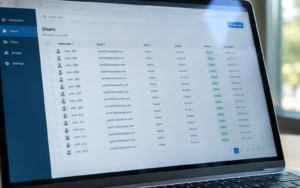
The applications we build are funded by clients, but that does not mean you have to pay to use them. A significant part of what we do is develop tools that make DHIS2 easier and faster to use: a suite of generic applications for user management, data import and export, training, and geospatial analysis. All of them are free and open source. The sustainability comes from organisations like WHO departments or Médecins Sans Frontières, who are already using these tools, need more functionality, and pay for our ability to develop it. And they believe, as we do, that the right thing is to make those improvements available to the whole community.
“We don’t sell code. We charge for our work and our ability to turn needs into functionalities.” Nacho Foche, founder and director
Beyond the generic suite, we also develop tailor-made applications adapted to the specific needs of the NGOs and departments we work with. In most cases, clients agree to release the code, which makes future development faster and more efficient for everyone. And software is only part of what we do: we also provide hosting and maintenance for DHIS2 platforms, training and consultancy.
Will others use our work without paying for it?
Yes, and that is the point. Our applications get forked and replicated. We do the same with other people’s work. For software that is used primarily in resource-constrained contexts, the ability to reuse is not a risk but a feature. We do not want to reinvent things that already exist. We want projects to move as efficiently as possible, and open source is essential to that. It also means clients can maintain their own applications without being permanently tied to us. We have had clients who have built the skills to do exactly that, and we think it is a good outcome.
The theoretical risk is that others will compete using our own code. In practice, working in a niche that requires deep, specific expertise means this has not been a threat. Building DHIS2 applications requires a team trained over a long period. And it is, for now, a market with considerably more demand than supply.
What we are most proud of
In ten years we have built emergency data systems for humanitarian situations like the war in Ukraine and the earthquake in Turkey, where delivering aid on the front line with no infrastructure means the data system has to work before anything else can. We have tracked the rollout of the malaria vaccine for millions of children. We have contributed to putting malaria research and treatment on the map and to solutions for neglected diseases that most of the world does not know exist.
We maintain the WHO Integrated Data Platform, where nine departments do their work in a more coordinated way, including monitoring universal health coverage and tracking antimicrobial resistance. And we have contributed to DHIS2 being adopted as WHO’s preferred health data collection system in contexts where it was previously absent.
Is it sustainable to work only for the good?
One challenge is always having enough projects to keep a team working. So far, that has been the case, partly because we are small enough that the threshold is not impossibly high. In ten years we have not had to lower our ethical standards to stay afloat. We have also learned that client diversification matters: depending too heavily on any single partner creates fragility.
The technological side has its own discipline. Working with public funds and NGO budgets means thinking about long-term maintenance from the start, choosing the most economical and efficient solutions. Two principles have proven themselves over time:
- Think generic whenever possible. Adapt existing solutions before building new ones. When existing ones were not good enough, we built them: Training App, Metadata Sync and much of the rest of the suite came from this instinct.
- Architecture at the heart of every project. Clean architecture is slower in the short term and significantly easier to maintain in the long term. For software that needs to run for five to ten years, the calculation is straightforward.
The model that puts people first
From the beginning, EyeSeeTea has wanted to be socially responsible both outward and inward. Inward means something specific: the freedom to determine how many hours you want to work.
The first thing people ask when they apply to work with us is whether it is true that they can choose to work fewer than 40 hours a week, and whether that choice is genuinely respected in practice. The answer to both is yes. A minority of people work full days; the most common choice is 30 hours a week, a compromise between more free time and a proportionally adjusted salary. And the flexibility to adjust that according to your life situation is one of the things most valued internally.
This is not cost-free. Giving everyone this degree of flexibility requires maintaining overcapacity, which requires capital. For years, that burden fell unevenly on management and project managers. It was a deliberate bet on reaching a point where the business could sustain that overcapacity properly. We are getting to that point.
We end with Nacho Foche’s own words:
“We want to make it possible to pursue happiness without it being obstructed by your work, one of the great challenges facing humanity today. Of course it is a big challenge. We are immersed in a system that optimises for profit, not happiness. That generates all kinds of challenges and tensions. We can do it partly because we are in technology, where considerably more capital moves than in other sectors. Many companies are still committed to the profitability paradigm. We believe that in our sector it can be done. What happens is that many times, they simply do not want to.“