Oslo in June. Three posters, two sessions, one app competition, and a community that keeps growing in all directions. DAC2024 was four days of conversations we could not have had anywhere else.
Our two co-founders, Nacho Foche and Adrián Quintana, attended in person. Almost the full team joined online. We came back with a first place in the app competition, two community awards, a long list of feedback on our tools, and a few new ideas we are already working on.
And the winner is: Metadata Sync
Metadata Sync, our metadata and data synchronisation solution for DHIS2, won the 2024 DHIS2 App Competition.
The app solves one of the most persistent operational headaches in multi-instance DHIS2 environments: keeping metadata consistent across servers. Whether you are pushing a configuration update from a staging environment to production, synchronising data between field and central instances, or managing a network of country deployments that need to stay aligned, Metadata Sync handles the orchestration without manual intervention or error-prone copy-paste. You can download it from the DHIS2 App Hub, find video tutorials and documentation on the Metadata Sync website, and explore the source code on GitHub.
d2-logger: logging that lives inside DHIS2
During the “Extending DHIS2” session, Nacho presented d2-logger, a logging library built to transmit operational log data directly into a DHIS2 instance.
The idea is straightforward: instead of managing a separate logging infrastructure, application operations generate logs that are materialised as events inside a DHIS2 program, where they can be queried through Capture, Event Reports, or any other DHIS2 analysis tool. This makes it possible to monitor extensive backend operations or consolidate operation tracking across multiple DHIS2 apps in one place, without leaving the platform.
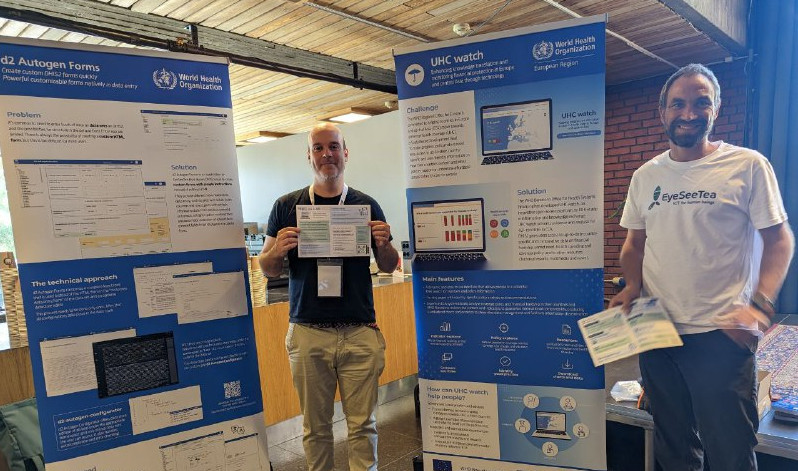
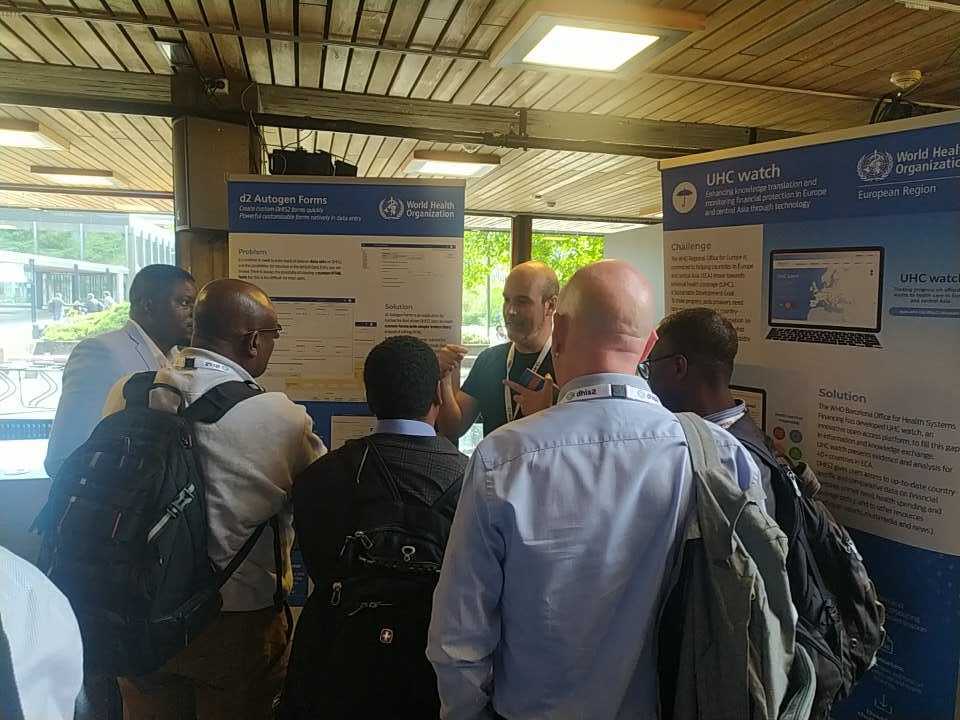
Three posters: autogen forms, d2-visualization and UHC Watch
Our three posters covered tools at different stages of maturity.
Autogen forms generates custom, React-based DHIS2 data entry forms automatically from a dataset’s structure, removing the need to hand-code the HTML. You can read the full write-up on our DHIS2 Community post.
The other two posters were connected to UHC Watch, a DHIS2-based platform we developed for WHO to monitor financial protection in health across Europe and Central Asia. Building it required extending DHIS2’s standard visualisation capabilities further than the Data Visualizer allows — adjusting fonts, colours, legends, labels and series in ways that simply were not possible out of the box. The result is d2-visualization, a customisable visualisation library for DHIS2 that we presented as a standalone tool. Check the poster and the UHC Watch development post for the full context.
Partners, feedback and conversations we did not expect
The conference always surfaces how our tools are being used in ways we never planned for. A few highlights from this year’s conversations:
The DHIS2 UiO core developers team (Austin McGee, Birk Johansson, Markus Bekken and Kai Vandivier) told us they had drawn on ideas from our d2-api library, which underpins all our apps, in their own TypeScript work. We also talked about new ways for the developer community to stay closer to UiO’s architectural decisions, and had some useful early conversations on extensibility.
Samaritan’s Purse gave us an update on Operation Christmas Child and opened discussions on upcoming projects, including requirement gathering for a new release of our data management app for them.
Simprints shared progress on the biometrics and malaria vaccination project in Ghana, where our customised DHIS2 Android Capture app is being used to track the rollout.
Clinton Health Access Initiative (CHAI) let us know they are using Metadata Sync in one of their projects in Burkina Faso.
MSF OCP found Metadata Sync useful and we helped them resolve some specific issues, as well as supporting their use of our d2-tools scripts for managing tracked entity instances and program stages.
HISP Tanzania confirmed that Metadata Sync, Bulk Load and User Extended are widely used across the community, and shared some specific use cases we had not heard before.
HISP Nigeria discussed autogen forms and our UHC Watch development.
Abt Associates, FHI 360 and the Uganda National Institute of Health all gave positive feedback on their use of our DHIS2 Suite apps, with FHI 360 in particular looking ahead to Bulk Load’s compatibility with DHIS2 version 40.
Resolve to Save Lives gave us the chance to compare notes on the official DHIS2 package we are building for WHO and their own Hypertension package, a conversation we came away from with a lot to think about.
Community awards
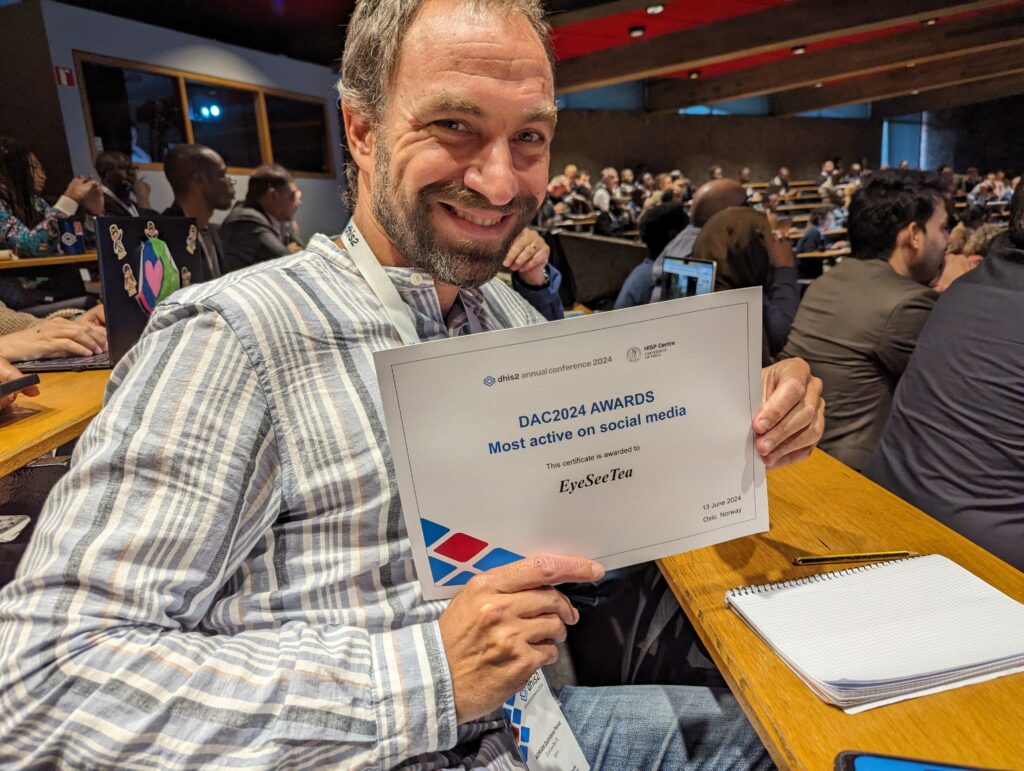
EyeSeeTea received two awards this year: Most active on social media and the Community of Practice activity award. Both mean a lot to us — sharing what we learn and staying present in the community is something we invest in deliberately, and it is good to see that investment recognised.
Thank you to the University of Oslo DHIS2 team for the conference, and to everyone who stopped for a conversation, gave feedback on our tools, or shared something from their own work. It is the part of the year we look forward to most.