Good connectivity should not depend on where you were born. That is the idea behind community networks, and it is exactly what the LibreRouter project was built to protect.
We are proud to share that LibreRouter, a project we have contributed to alongside partners from Argentina, South Africa and beyond, has been awarded a FIRE Africa Technical Innovation Scale-up Grant. The award recognises initiatives that have made concrete, demonstrable contributions to social and economic development in Africa through the use of information and communications technologies.
Where the project began: Mankosi
To understand why LibreRouter exists, it helps to start in Mankosi, a rural community in the Eastern Cape province of South Africa. The University of the Western Cape (UWC) has been researching low-cost communications solutions for rural areas since 2003, driven by a stark reality: communities in the region live on average individual incomes below two US dollars a day, yet spend up to 22% of their disposable income on mobile communications. For them, connectivity sits alongside food, shelter and transport as a basic necessity, and the market was not serving them well. Only 22.2% of people reported using the internet on a monthly basis, and those who did reported a very constrained experience.
In 2013, UWC partnered with Mankosi to create Zenzeleni Networks Mankosi (ZNM), deploying a WiFi mesh network of 12 routers across the community. Connected via analogue phones, residents could make free intranet VoIP calls and break out to external calls at half the price charged by commercial mobile operators. Beyond the service itself, ZNM established a legal precedent: the first bottom-up operator recognised within South Africa’s regulatory framework, opening the door for other community-run networks to follow.
The problem community networks were running into
Community networks like ZNM have always depended on modifying off-the-shelf routers to run open-source firmware suited to their specific conditions: mesh topologies, low power budgets, difficult terrain, limited line of sight. It worked, until it stopped working.
New regulations from the US Federal Communications Commission (FCC) pushed hardware manufacturers to globally lock their devices against third-party modifications. The routers communities depended on became closed boxes. The firmware they had built their networks on could no longer be installed. The technical foundation of community internet, built over years of collective work, was being cut off from its own hardware.
Building the router that communities actually need
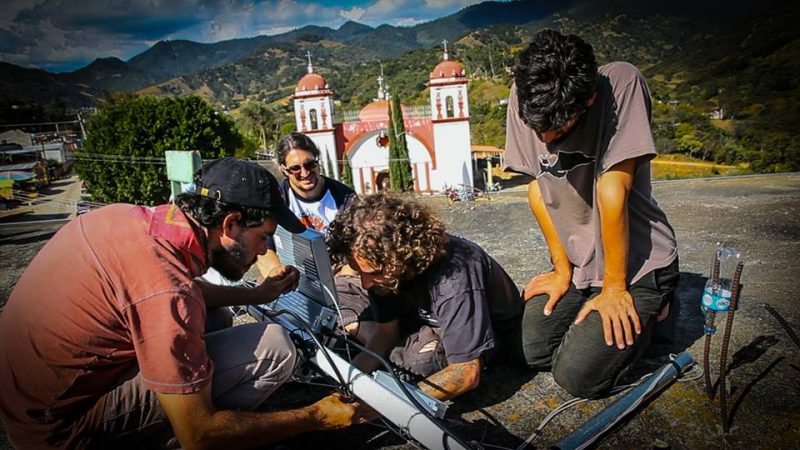
The LibreRouter project was born from that moment. Led by the University of the Western Cape and AlterMundi (Argentina), with the participation of Zenzeleni Networks, Guifi.net, EyeSeeTea and a wider group of community network practitioners and researchers, the project set out to design and manufacture an open hardware router built specifically for the conditions of the Global South.
The guiding principle, as AlterMundi’s Nicolás Pace put it, was to design from the community up, not from the computer desk. That meant taking seriously the things commercial manufacturers do not: remoteness, limited digital skills, constrained power supply, repairability with locally available parts, and the cultural specificities of who runs the network and why.
The result is a high-performance multi-radio wireless router running LibreMesh firmware on top of OpenWRT, with dual 5GHz radios capable of 300 Mbps throughput, a 2.4GHz radio for client devices, lightning protection hardware, and the ability to run on battery, solar or mains power. Every component chosen with stability, efficiency and field repairability in mind.
EyeSeeTea’s contribution
Our role in the project focused on two areas of software development.
The first was a power-saving strategy for the router hardware. Energy constraints are real in rural deployments where mains power is unreliable or unavailable, and reducing power consumption directly affects how widely and sustainably the router can be deployed. We built and open-sourced the testing infrastructure for these power efficiency solutions so the community could validate and build on the results.
The second was a WiFi Calling application that addresses one of the most practical questions a user in a community network faces: should I make this call through the community network or through my GSM provider? The app uses hybrid technology to inform the user in real time about the cost of each option and lets them choose the cheapest route, whether that is a free intranet call over the community mesh or a break-out call through a mobile operator. It is a small interface decision with a real impact on household spending.
The FIRE Africa award
FIRE Africa (Framework for Responsible Internet Expansion) supports projects that expand internet access and use across the African continent. The Technical Innovation Scale-up Grant awarded to LibreRouter, worth $30,000, joins FRIDA and interregional funding to bring the total project support to over $100,000, a significant vote of confidence in an approach that prioritises open hardware, community sovereignty and long-term sustainability over commercial viability.
The project has already attracted interest from community networks in more than 40 countries, across Africa, Latin America, Europe and Asia.
Open source as a design philosophy
For us, participating in a project like LibreRouter is an extension of the same commitment that shapes how we build tools for global health: open source means building things that outlast any single project, that can be adapted by the people who need them, and that contribute to a commons that everyone benefits from.
The communities deploying LibreRouter in rural South Africa and the health teams using our DHIS2 applications in the field are working in very different domains. But the underlying question is the same: how do you build technology that serves the people who need it most, on their own terms?