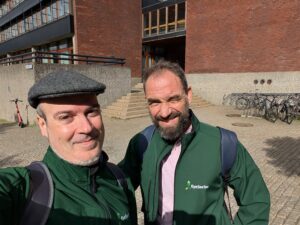
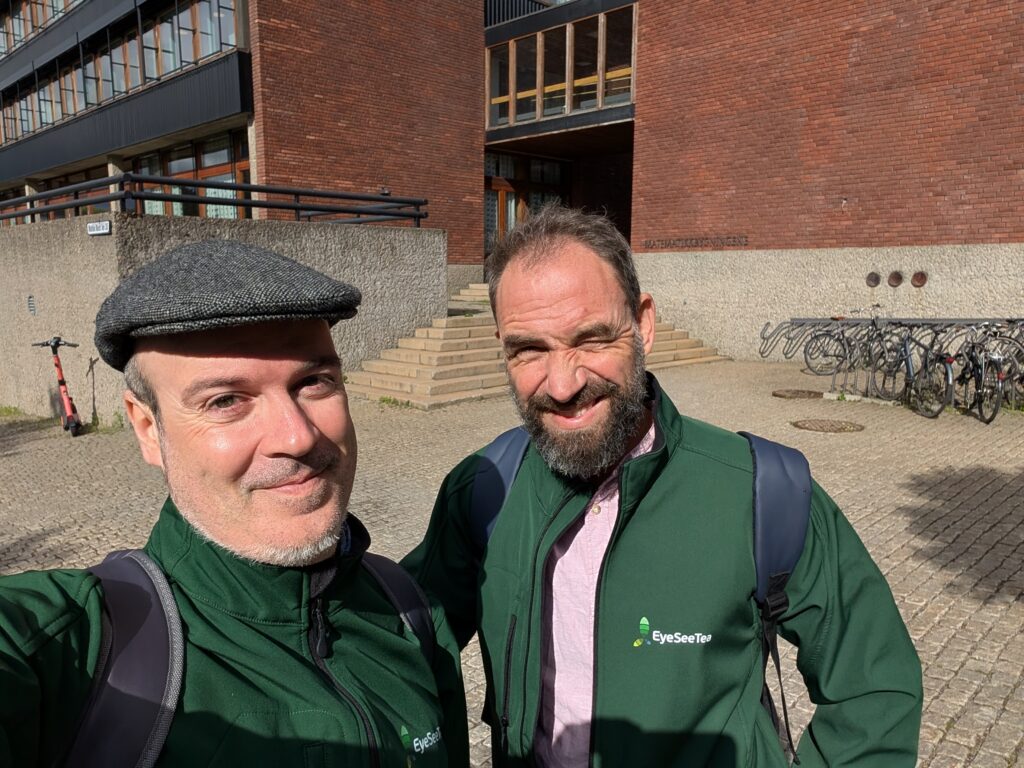
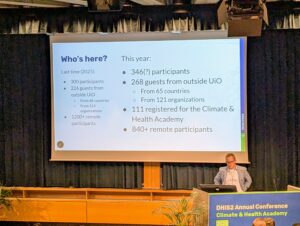
This year’s DHIS2 Annual Conference (#DAC2026) wrapped up in Oslo, and it’s been four packed days of lightning talks, technical sessions and the kind of conversations that only happen once a year, with the whole community in one room. We gave two lightning talks, took part in a session on building Capture plugins, submitted two award nominations, entered four tools into the app competition, and brought home the “Most active on social media” diploma for the third year running.
"In a world where much of the news is dominated by war, conflicts, barriers, diseases and climate-related shocks, there is something profoundly encouraging about being here today with you."
For the first time, the conference ran alongside the brand-new DHIS2 Climate & Health Academy, which meant an extra current of climate-and-health content running through the week, on top of the usual mix of keynotes, country implementation stories, technical sessions and poster presentations. As always, the best part wasn’t on the agenda at all: it was the corridor conversations, the partners we only get to see once a year, and finding out who’s been quietly using one of our apps without us even knowing.
Extending DHIS2 Capture, with Samaritan’s Purse
At the point of care, paper is faster than any digital workflow, but the program teams behind that care still need structured, auditable data. DHIS2 covers the data side out of the box; what it doesn’t do alone is reach the clinic floor. That gap was the subject of our first lightning talk, built around Samaritan’s Purse’s Community Medical Outreach (CMO) clinics, weekend pop-up events where volunteers provide free dental, vision and medical care to underserved US communities.
Our approach: don’t replace DHIS2 Capture, extend it. We embedded Capture in a single host app and added toolbar extensions for SMS reminders, built on DHIS2’s native messaging with templates the program team manages itself, and DYMO label printing pulled straight from the patient record, plus two lightweight plugins for things like ZIP code lookups and date-of-birth handling. The result: a full clinic day, from pre-registration to discharge, tracked end to end on a single dashboard.
If “build it for one partner, design it so it can travel” sounds familiar, it’s the same instinct behind our work with Samaritan’s Purse on Operation Christmas Child.
Metadata as code
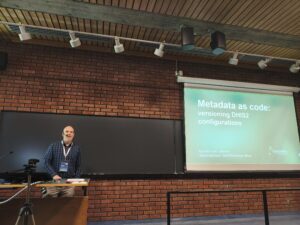
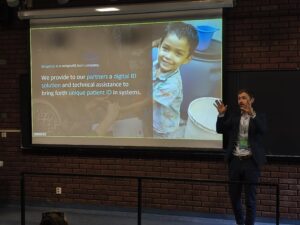
Our second lightning talk, given by our director Nacho Foche, tackled a problem every DHIS2 implementer knows: it’s not the data that’s fragile, it’s the configuration behind it. The same server can be a logistics platform, a civil registry or a surveillance tool; metadata is the only thing that tells them apart, yet most teams couldn’t say whether they can roll back a past metadata state, work on it safely in parallel, or trust a version history at all. In practice, the live instance quietly becomes the source of truth, until a real project’s rollbacks and parallel changes break that arrangement.
The repo becomes the single source of truth — never the instance again.
Our practice is to treat metadata like source code, inheriting the same things version control solved decades ago: versioning, diffs, automated validation and reproducibility. We demoed it live, adding one data element to a Sierra Leone test repo, validating it, and syncing it back to the instance, using five building blocks: Git, a skeleton repo with build scripts, a reproducible deploy layer, our own DHIS2 apps, and a set of AI agents that drove most of the demo through plain language. Two of those apps are ones the community can use today: our Metadata Comparator, and Metadata Visualizer, which renders any metadata package as a dependency graph before you trust it.
Building DHIS2 Capture plugins
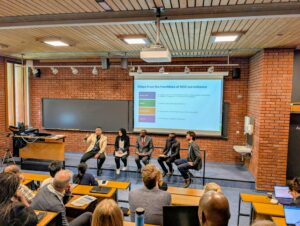
Our director Ignacio Foche and CTO Adrián Quintana took part in a session on the right way to extend Tracker programs with custom field logic, without forking Capture’s core. A plugin attaches through the Tracker Plugin Configurator, runs in a sandboxed iframe, and talks to Capture through a small, typed contract instead of raw DHIS2 IDs.
They walked through four production patterns, headless logic, safe external lookups through DHIS2 Routes, configuration-driven content stored outside the code, and cross-app communication, including a real example: an Aggregate Data Entry plugin running inside the Vaccination App we built with MSF. They closed with an honest take on AI-assisted development: more time on design and testing, less on raw implementation, and a habit of asking the AI to challenge their thinking rather than just confirm it.
Awards
For the Impact Award, we nominated our Vaccination App, built with Médecins Sans Frontières, which has carried 55 vaccination campaigns since October 2020. The goal was to remove the technical friction that slows down a humanitarian response: a tool simple enough for non-experts to configure rapidly in the field, yet able to handle dozens of antigens, each with its own age groups, doses and indicators, over connections that can’t always be trusted. Five years on: 55 campaigns across nine countries, more than 3,000,000 doses administered against 20 antigens, including around 2,800,000 for children under 14 and 420,000 for infants under one.
For the Contribution Award, we nominated something less single-project and more decade-long: our entire DHIS2 Suite, more than ten generic, open-source applications built on the idea that the most powerful digital health tools should be global public goods. Tools like User-Extended and MetaData Sync, in daily use by WHO, Samaritan’s Purse and MSF, started life in DHIS2 2.26 and 2.30 and are still maintained today on 2.40. The full portfolio: Bulk Load, Dashboard Reports, our Google Earth Engine module and its Data Importer, Homepage, MetaData Synchronization, Sharing Settings, Tally Sheets, Training App, User-Extended, and our newest addition, Data Quality Extended.
And on the way out, EyeSeeTea picked up the “Most active on social media” diploma for the third year in a row. We love sharing what’s happening across the community, so this one always means a lot.
Four apps, one competition
Alongside the two award nominations, we also entered four of our tools into this year’s app competition.
D2 Autogen Forms turns a dataset’s sections and data elements into a fully custom, React-based data entry form, no one has to hand-code the HTML. Point it at a dataset, and it generates a form ready to paste straight into DHIS2 as a custom data entry form. Metadata Comparator is the semantic diff-and-merge tool we leaned on during the Metadata as Code talk, turning a 10,000-line JSON headache into a side-by-side view you click through. Metadata Visualizer lets you query an instance or a raw JSON package and see the result as an interactive dependency graph instead of scrolling through nested JSON, the same tool we used to check a new field’s wiring before it ever reached a server. And Data Quality Extended turns data validation from a one-time check into a trackable, assignable, auditable workflow.
Thank you to the DHIS2 team for putting together another conference worth flying to Oslo for. If any of this, the Capture plugins, the metadata practice, the Vaccination App, or anything else, sounds like something your team is wrestling with too, reach out, we’d love to talk.
Subscribe and start learning.
Join our newsletter to learn about the real work behind building humanitarian infrastructure. Every tool, every insight, open for you to use.
What you will find inside:
From complex DHIS2 architectures to fast deployments in critical zones, logistics, disease surveillance and data visualization — plus a look inside how we work and think at EyeSeeTea.