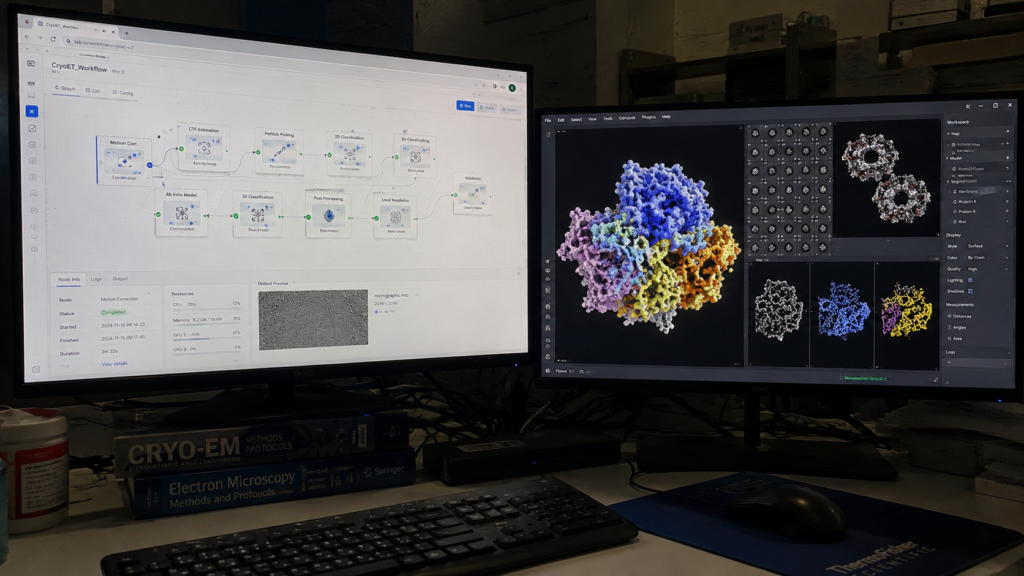
A single session on a high-end electron microscope can generate up to 2TB of data in a day. Turning that data into a 3D model of a protein complex requires hundreds of processing steps, using software tools built by different labs, in different programming languages, with different data formats, each developed independently and largely unable to talk to each other. Before Scipion, that was a researcher’s problem to solve alone.
EyeSeeTea worked with the Instruct Image Processing Center (I2PC) at the Spanish National Center for Biotechnology (CNB-CSIC) on Scipion, an open source image processing framework for obtaining 3D models of macromolecular complexes using cryo-electron microscopy (cryo-EM). I2PC is part of Instruct-ERIC, the European research infrastructure for integrated structural biology, and provides image processing support to structural biologists across the continent.
Why cryo-EM needed a framework like Scipion
The past decade has seen a revolution in 3D electron microscopy (3DEM): the instruments have become dramatically more powerful, the resolution achievable has transformed what structural biologists can see, and the software ecosystem has expanded to match, with dozens of specialised tools developed by research groups worldwide for tasks like particle picking, 2D and 3D classification, volume reconstruction, and atomic structure determination.
The problem is that this ecosystem grew organically, without coordination. Tools like Xmipp, EMAN, Spider, Relion, Frealign, cryosparc and ctffind each solve important problems, but they were built in different languages, expect data in different formats, and cannot easily be chained together into a reproducible pipeline. A researcher wanting to combine the best algorithm from one package with the best visualisation from another had to manage the handoffs manually, keeping track of which version of which software processed which dataset, and hoping they could reconstruct their own workflow later.
Reproducibility (the ability to re-run an analysis with the same inputs and get the same outputs) is a foundational requirement of scientific work. In 3DEM, it was extremely difficult to guarantee.
Scipion’s approach: a workflow layer above the tools
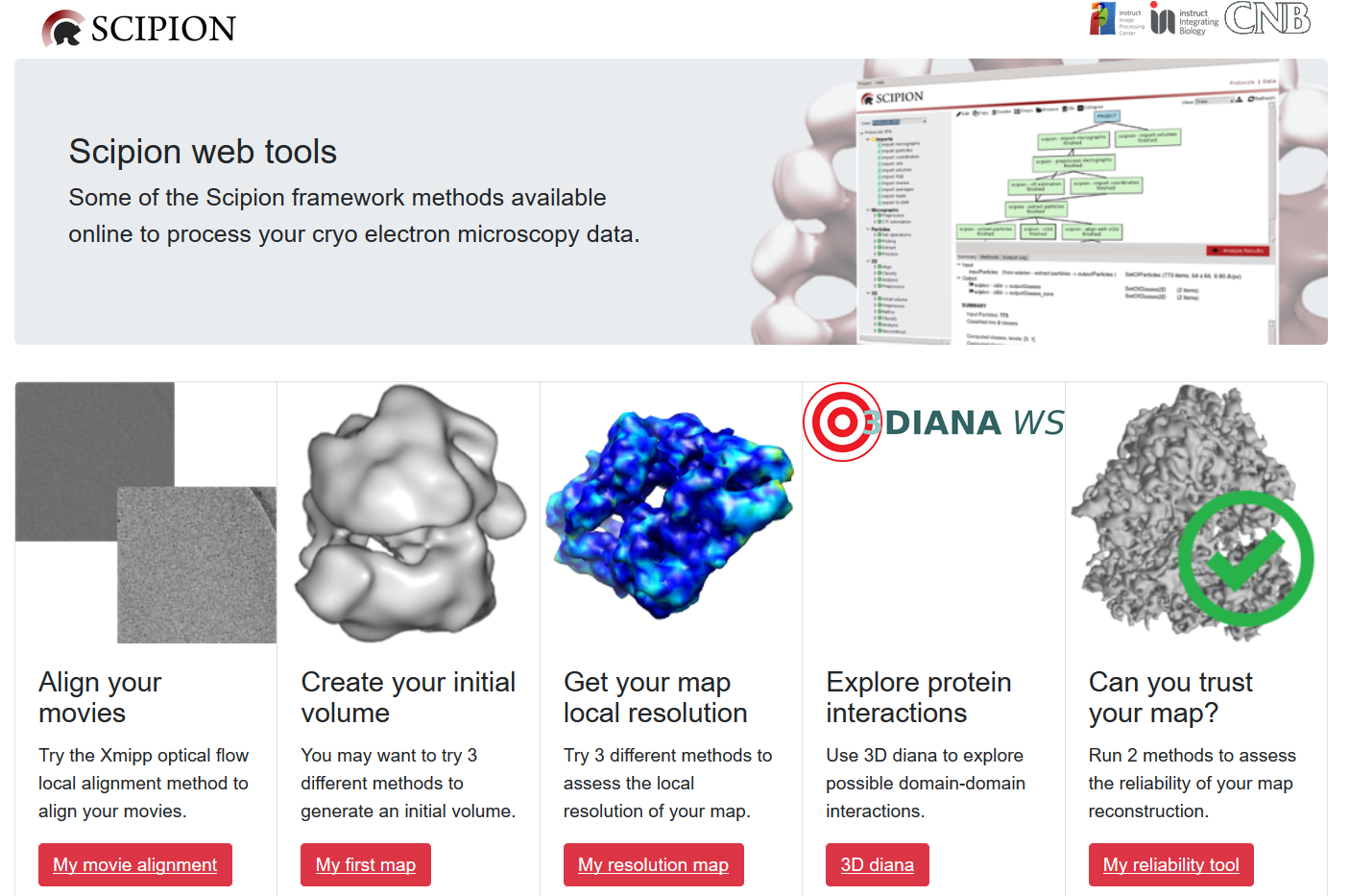
Scipion addresses this by sitting above the existing tools rather than replacing them. It provides a unified, workflow-oriented interface where researchers design their processing pipeline visually, selecting protocols from any of the integrated software packages, and Scipion handles all format conversions, data handoffs and version tracking automatically. Every step is recorded, every intermediate result is traceable, and the entire workflow can be reproduced later, by the same researcher or by anyone else.
The result is a platform that combines the best of the global 3DEM software ecosystem into a single reproducible process, without requiring any of the underlying tools to change.
EyeSeeTea’s contribution
Our work with I2PC covered two areas: software development audits to improve the engineering processes behind Scipion’s R&D, and product and project management to bring coordination and rigour to a project that involved multiple international centres contributing code independently.
The collaboration ran deep enough that our director Ignacio Foche and CTO Adrián Quintana are named as co-authors on the foundational Scipion paper published in the Journal of Structural Biology in 2016, alongside the CNB team. That level of involvement reflects what the project actually needed: not just external reviewers, but people embedded in the development process, helping to resolve the coordination and architecture challenges that come with integrating an ecosystem as heterogeneous as 3DEM’s software landscape.
The ongoing results were visible: the number of integrated protocols increased significantly, coordination between the contributing centres improved substantially, and Scipion became the standard framework for cryo-EM image processing support at I2PC and across the Instruct network.
A collaboration that has continued
The success of the Scipion project led to an ongoing relationship with CNB. We have continued to collaborate on web development and maintenance, cluster infrastructure management, and server configuration, the kind of long-term technical partnership that emerges when a project goes well and trust is established.
Scipion has since grown into Scipion3, with active development, a dedicated Slack workspace for facility managers and developers worldwide, and courses taught at institutions from Cambridge to Stockholm. It remains one of the clearest examples in our portfolio of what good open source software stewardship looks like: a community that keeps growing because the foundations were built carefully.
Outside our usual domain, but not outside our values
EyeSeeTea’s work is concentrated in global health data systems, primarily around DHIS2. Scipion sits in a very different world: structural biology, academic research infrastructure, European science consortia. But the underlying challenge is one we recognise immediately: how do you build software that enables a distributed community to collaborate, produce comparable outputs, and trust the results? That is a question we work on every day, whether the domain is cryo-EM or malaria surveillance.