An estimated 850 million people worldwide lack formal identification. In global health, that number translates directly into a question that is surprisingly hard to answer: did this child receive their last dose?
Simprints and EyeSeeTea are working together to answer that question in Ghana, in partnership with the Ghana Health Service, with support from Gavi, Arm, and the Steele Foundation for Hope. Together, we have built a biometric mobile solution that tracks the rollout of the malaria vaccine across two regions of the country, making it possible for frontline health workers to verify, in real time, that every dose reaches the child it was intended for.
The problem that paper cannot solve
The malaria vaccine (RTS,S) requires four separate, accurately timed doses to provide full protection. In communities where paper-based records are the norm, tracking a child through a four-dose series over months is genuinely difficult. Records get lost. Names are spelled differently across visits. A child seen at one clinic may not be recognised as the same child at another. The result is children who drop out of the series before the crucial final round, and programme teams with no reliable way to know how many people are actually protected.
The underlying challenge goes deeper than logistics. Across low and middle-income countries, communities are missing out on healthcare they are entitled to because there is no safe, reliable way to connect a person to their health record. Without a unique, verifiable identifier, every follow-up visit starts from scratch.
“Data is everything. The beauty of the biometric component is that it makes it easy for patient registration, identification and follow-up.” Dr John Ekow Otoo, Deputy Director, PH, Eastern Region, Ghana Health Service
What Simprints brings
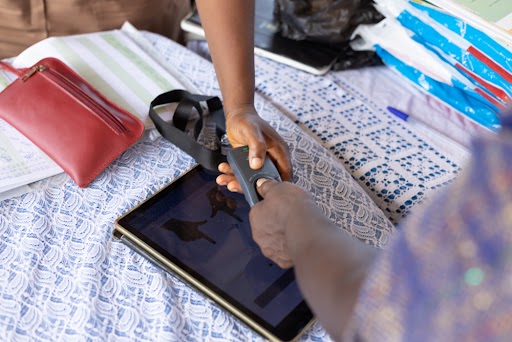
Simprints develops biometric identity solutions specifically designed for last-mile health contexts, active in seventeen low and middle-income countries. Their Vero scanner captures fingerprints in the field, including a contactless modality that works even when hands are wet or worn, and links each person to a unique digital health record, eliminating duplicates and making follow-up possible regardless of whether a patient can recall their name in a registration system or present a paper card.
The biometric workflow covers three actions: enrolling a new patient by capturing their biometric data and linking it to a DHIS2 record; identifying a returning patient from their fingerprint alone; and verifying that the person presenting matches a specific record. Once biometrics are complete, the health worker is presented with a list of matched records in the DHIS2 app and selects the correct one to proceed with the visit.
What EyeSeeTea builds and maintains
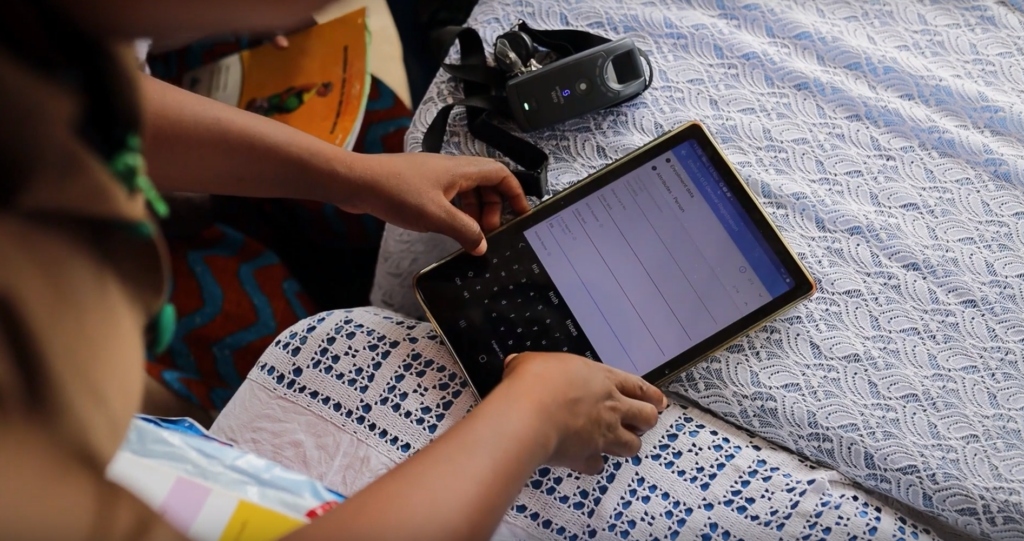
Our role is the data layer. We develop and maintain a customised Android Capture App, built on DHIS2, the world’s largest open-source health management information system, currently deployed in more than 100 countries. The app integrates directly with the Simprints SDK, handling biometric capture and patient identification within the same interface health workers use for all other data entry.
DHIS2 stores every vaccination record securely, tracks each dose in the series, and feeds the programme’s monitoring dashboards with reliable, deduplicated data. EyeSeeTea’s expertise with DHIS2 ensures that Simprints’ biometric identification connects to a data infrastructure that can support programme-level decision-making, not just individual record lookup.
This is a first for Ghana: the first biometric technology designed specifically for last-mile frontline health workers, with both contact and contactless modalities, integrated into a national health data system.
Why it matters beyond the numbers
Maximising vaccination coverage in a four-dose series is, at its core, a data problem. Knowing who received dose one is how you know who needs dose two. Knowing who completed the series is how a programme team can identify the communities where children are dropping out, and redirect outreach accordingly.
Biometrics makes the data reliable. DHIS2 makes it usable. The combination is what moves a campaign from “doses administered” to “children protected.”
Simprints and EyeSeeTea continue to work together to improve the user experience and expand the project’s reach in Ghana. You can read more about our broader work in malaria and global health in Fighting malaria with technology.