There are not enough dermatologists in the world to diagnose the millions of people affected by skin-related neglected tropical diseases. In low-resource settings, the gap falls on primary care workers with little or no dermatology training. An AI-powered app being tested in Kenya may be about to change that equation.
More than 1.5 billion people worldwide are affected by neglected tropical diseases (NTDs), primarily in low and middle-income countries. More than half of NTDs present with skin manifestations and can cause long-term disability, stigma and mental health problems. When properly diagnosed, many of them are treatable.
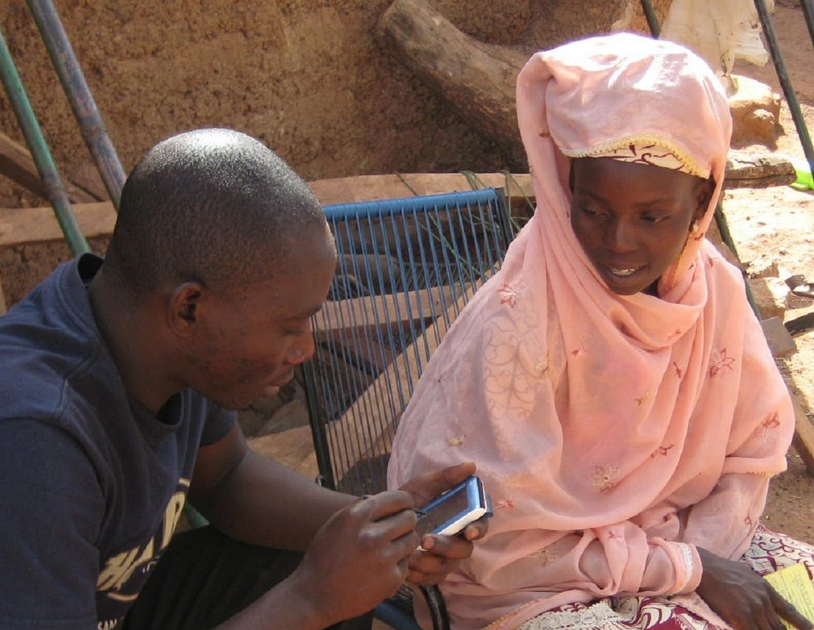
The diagnosis is the problem. Field workers who encounter skin lesions daily often lack the training to distinguish between leprosy, leishmaniasis, scabies or the 24 other common skin conditions that look similar to the untrained eye. Primary care workers in these contexts correctly diagnose skin lesions approximately 30 to 40 percent of the time. That number has consequences.
“There are not enough dermatologists in the world to handle millions of people affected by skin diseases. Health workers in the field are key to managing these diseases. So, we conceived this app as a practical way to digitise a manual that can’t be carried in a pocket and that WHO can’t print to give to all the health workers on the planet.”
Dr José Antonio Ruiz-Postigo, Medical Officer, Global Neglected Tropical Diseases Programme, WHO
The SkinNTDs app and its AI expansion
WHO introduced the SkinNTDs app as a clinical decision support tool for frontline health workers. In its original form, the app uses an algorithm to help workers make more accurate diagnoses and treatment decisions, alongside a learning section with training materials. Field feedback has been consistently positive.
A collaboration between WHO, Universal Doctor and Belle.ai has now added a significant new layer: two AI-based algorithms that classify photos of skin lesions uploaded by health workers, producing a ranked list of likely diagnoses in seconds. The beta version covers 12 skin-related NTDs (including leprosy, leishmaniasis and scabies) and 24 common skin conditions.
The underlying technology is a Convolutional Neural Network (CNN), a type of AI model that learns to identify visual patterns by processing large volumes of labelled examples. The breadth and diversity of the image dataset used during training directly determines the accuracy of the model in recognising conditions it has not seen before.
Dr Ruiz-Postigo is clear about the intent and the limits: “The important thing is to be clear about the benefits and limitations of AI as a tool to help improve patient care. The ultimate goal is to augment human intelligence.”
The evaluation app EyeSeeTea built
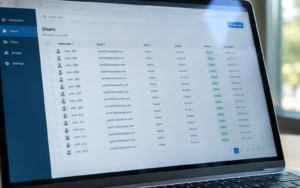
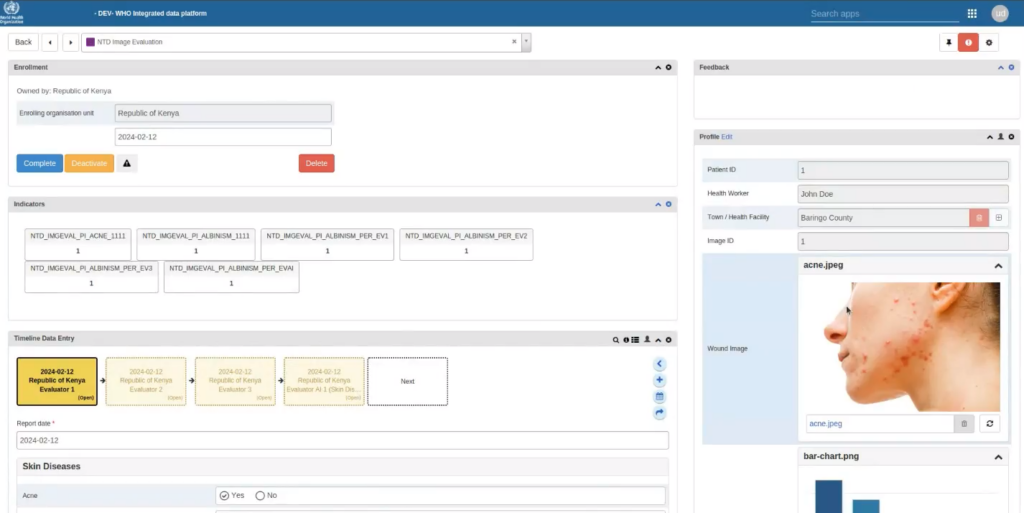
Before any AI model can be deployed at scale, its accuracy needs to be measured against expert clinical judgement in real-world conditions. EyeSeeTea developed a DHIS2-based evaluation application specifically for this purpose.
In the Kenya field study, health workers used the app to upload more than 600 patient images. Three independent dermatologists then diagnosed the same images using the same application, each working without visibility of the others’ assessments. The application tracked and compared the AI model’s classifications against the dermatologist consensus.
“It is always so rewarding to work on a project such as this. We combine the powerful DHIS2 open source software with cutting edge AI models to fight neglected diseases. It is an incredible opportunity to work with experts such as José Antonio Ruiz.”
Ramón Jiménez, Project Manager at EyeSeeTea
The results are significant. The AI’s sensitivity in identifying skin NTDs is approximately twice that of a regular primary care worker, against a baseline of 30 to 40 percent correct diagnoses. For a condition where early detection determines whether a patient is treated or deteriorates, that gap matters.
What comes next
The study, conducted in collaboration with Kenya’s Ministry of Health, will be published in a peer-reviewed journal. The next phase will replicate the evaluation in Côte d’Ivoire and Cameroon, with evaluating dermatologists working from images alone, with no accompanying clinical information, providing a stricter test of the AI’s standalone diagnostic capability.
If the results hold, this tool could meaningfully shift what is possible for frontline workers dealing with skin conditions across endemic regions. One of the WHO’s 2030 targets for NTDs is a 90% reduction in the number of people requiring interventions against these diseases. Reaching that target depends, in part, on diagnosing the people who currently go undiagnosed. That is what this application is designed to help with.
Additional resources
- WHO Skin NTDs App: Apple App Store — Google Play
- Study protocol: Assessing the Quality of the WHO’s Skin NTDs App as a Training Tool in Ghana and Kenya (PubMed)
- Results: Evaluating the WHO’s SkinNTDs App as a Training Tool for Skin NTDs in Ghana and Kenya (PubMed)