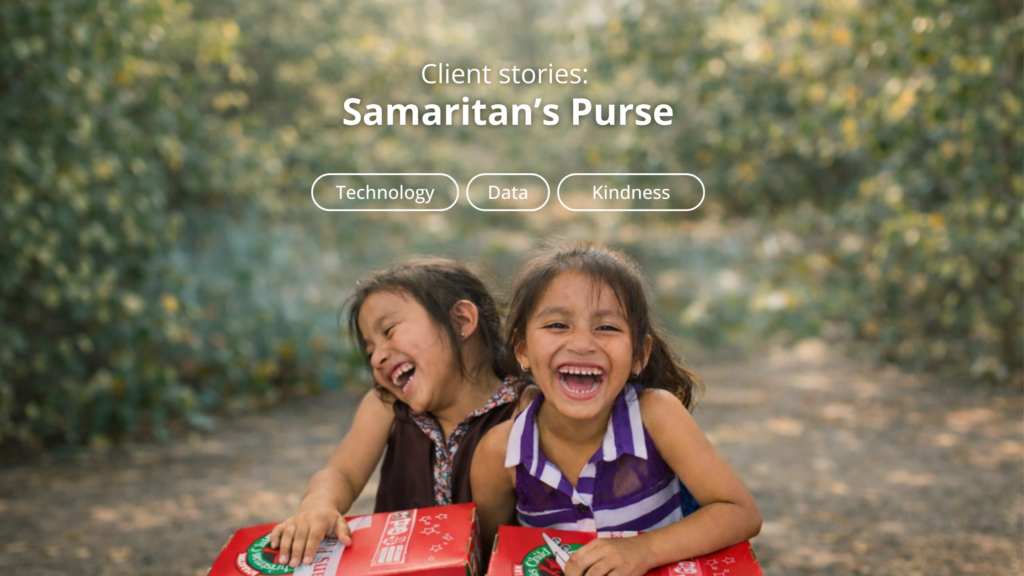
This post is about a meaningful collaboration we are privileged to work on: Operation Christmas Child, a global programme run by Samaritan’s Purse. Operation Christmas Child collects shoeboxes filled with small gifts such as toys, school supplies and hygiene items. Prepared by volunteers, these shoeboxes are delivered to children in communities facing difficult circumstances, across many countries around the world.
When technology stays in the background, people can focus on what matters most: delivering impact, not managing complexity.
Behind this global effort sits a huge amount of global programme coordination. Thousands of local teams, volunteers and partners organise distributions, manage resources and report on what is happening on the ground. When this coordination works well, more children can be reached and support can be delivered more effectively.
We’re proud to contribute to this work by supporting the planning and reporting systems behind it. Our role is about helping the people involved plan better, coordinate better and understand their work more clearly. This project is a good example of how technology for social impact, when designed carefully, can quietly support large-scale programmes.
The challenge: coordinating a global programme at scale
Running a programme like Operation Christmas Child is not simple. It operates across dozens of countries and involves thousands of people: local teams, volunteers, coordinators and partners. Each group plays a role in programme planning and reporting, managing resources and documenting what has been done.
As the programme grew in size and reach, everyday work naturally became more complex. Teams had to manage more information, more coordination and more reporting across countries and seasons. Getting a clear, up-to-date picture of what was happening everywhere at once was not always easy, and learning consistently from previous seasons required extra effort.
What was needed was a clearer, more connected way of working. Something that could support large-scale programme management, planning, follow-up and reporting in a consistent way, while still respecting how different teams operate on the ground.
The solution: a shared planning and reporting system
Together with Samaritan’s Purse, we worked on a solution built around one clear idea: create a shared planning and reporting system that supports teams at every level, without adding unnecessary complexity.
Instead of relying on multiple tools or disconnected processes, the goal was to bring everything into one place. A place where teams could plan their activities for a season, track what is happening as the work progresses, and report on results in a consistent and structured way. Information entered once can be reused wherever possible, reducing repetition and saving time.
We focused on making the system fit real workflows. Different teams work in different contexts, but they still need a common structure that helps them stay aligned. Clear guidance, built-in checks and shared definitions help ensure that information is consistent, while still leaving room for local realities.
At the same time, the solution needed to work at scale. It had to support local teams in their daily work, while also giving coordinators a clearer overview across countries and seasons. This makes it easier to understand what is happening, spot patterns and learn from one season to the next.
The result is a practical, shared system that supports data-driven coordination across the entire programme.
Tech hats on!
If you want to know how this works under the hood, this section is for you.
The Central Planning and Reporting solution is built as a DHIS2 implementation, using DHIS2 as the core open-source data platform for data collection, aggregation, monitoring and analysis. Rather than replacing DHIS2’s standard capabilities, the approach was to extend and orchestrate them to support the specific workflows of Operation Christmas Child.
At the centre of the solution is a custom DHIS2 web application that acts as the primary user interface. This app sits on top of the DHIS2 API and provides a single, coherent entry point for users, covering planning, reporting, profiles, logistics and approvals. Its role is to shield users from DHIS2’s internal complexity while still leveraging its full power.
Some parts of the application build on and enhance existing DHIS2 capabilities, such as data entry and visualisation, while others introduce fully custom views and logic designed around the real needs of users. This balance allows teams to benefit from DHIS2’s strengths without being constrained by a one-size-fits-all interface.
From a technical perspective, the app is a React + TypeScript application, following a modular, domain-driven structure. Business logic is clearly separated from presentation, with domains, entities, use cases and repositories organised explicitly in the codebase. This makes the application easier to reason about, test and evolve over time.
Interaction with DHIS2 is handled through typed APIs, using EyeSeeTea’s internal libraries to ensure safe and predictable communication with the backend. Much of the programme logic (validations, calculated values, and dependencies between datasets, events and indicators) is enforced directly at the DHIS2 level. This shifts complexity away from manual processes and into the system itself, improving data quality and consistency by design.
The solution is also intentionally modular. Core programme areas such as planning, grants, reporting, logistics and team management are connected through shared metadata and rules, but implemented as distinct functional modules. This allows individual components to evolve without tightly coupling the entire system, supporting long-term maintenance as programme needs change.
Finally, the platform is supported by scheduled server-side processes that handle data synchronisation, derived value calculation, cleanup of soft-deleted data and cross-level data propagation. These background processes ensure that aggregated data, indicators and reports remain accurate and up to date, without adding extra burden on users.
In short: DHIS2 provides the engine, the custom application defines the workflow, and a carefully designed architecture supports scalable, maintainable global programme delivery.